Don't Bite the Hand That Fuels You - Fossil Fuel Subsidies
Who Is Our Energy Policy Really Serving?
Australia keeps saying yes to new coal and gas while asking its Pacific neighbours to trust it on climate. Those two things don't sit together, and our neighbours have noticed.
The old saying is "don't bite the hand that feeds you." In Australia's energy politics, the rule seems to be don't bite the hand that fuels you. Our biggest gas buyers and investors, led by Japan, shape what Canberra and the states will and won't do. The cost of that loyalty is paid in the Pacific, on the Reef, and in our kids' future.
From Far North Queensland, we live with the Reef on one side and the Pacific on the other. That's why Circular Economy FNQ is asking a simple question: who is our energy policy really serving?
Fossil Fuels Subsidies At Home: Two States, Same Direction
On 30 September 2026, the NSW Independent Planning Commission approved the biggest coal project in the state's history. Glencore and Yancoal's Hunter Valley Operations Continuation Project can now dig about 430 million tonnes of coal into the 2040s.
The Climate Council puts the climate cost at more than 800 million tonnes of pollution. Only 15.1 million tonnes of that happens at the mine. The other 793.8 million tonnes is released when the coal is burned, mostly overseas. The project still needs federal approval under the EPBC Act, so Canberra gets the final say.
Queensland is heading the same way. In March 2026, the Crisafulli Government approved Glencore's Hail Creek expansion, adding 29 million tonnes of coal and clearing 600 hectares of "nationally significant" koala habitat next to Homevale National Park. Different premiers, different parties, same answer: more coal.
Queensland: fossil-fuelled AI, with an Olympics to sell
Queensland is going further than any other state in insisting it can power AI data centres with coal and gas. The federal government wants new data centres to pay for new renewable energy, not coal or gas. Premier Crisafulli wants it "technology-agnostic".
After national cabinet in August 2026, Crisafulli said he was "very, very firm on making sure that we got a carve-out" and claimed he got one. Energy Minister Chris Bowen says neither Queensland nor the Northern Territory did. Either way, Queensland is the state publicly fighting for fossil-fuelled AI.
The stakes are huge. The 1.44 GW Western Downs Digital Park near Dalby, which AI company Anthropic has signed a $32 billion deal to use, will run on a mix of gas, renewables and batteries.
The Climate Council says this one facility could use three times more power than Brisbane's 1.4 million residents.
Now look six years ahead. Brisbane hosts the 2032 Olympics. Queensland's Destination 2045 tourism plan promises 45 new eco-tourism experiences and aims to double visitor spending to $84 billion a year.
By 2032, regenerative tourism should be in full swing, and the world will be watching.
You can't sell the world regenerative tourism while approving new coal, gas and fossil-fuelled data centres. It's an oxymoron. The Games have already quietly lowered the bar: in 2024 the host contract was changed so Brisbane 2032 is no longer legally bound to be "climate positive". It's now just an aim. If we keep going this way, Australia risks egg on its face in front of a global audience.
Hard next-step questions
- Did Queensland get a data centre carve-out or not? Ask for the national cabinet record.
- How much gas will Western Downs burn each year, and who pays for the new supply?
- Who decided to drop "climate positive" from the Olympic host contract, and who signed it?
- How will Destination 2045 measure "eco-tourism" against the emissions of new fossil fuel projects?
Our Taxes Are Paying Them To Do It
Australian governments now hand fossil fuel producers and big users $16.3 billion a year. That's up from $11.1 billion just three years earlier, according to The Australia Institute's annual audits.
The biggest single item is the federal Fuel Tax Credit Scheme, at $10.8 billion in 2025–26. Subsidies are now growing faster than the NDIS. Figures: 2026 report, 2025 report, 2024 report.
Put simply, that's about $5 billion more a year than three years ago. Imagine that money going into regional renewables, repair hubs, or getting kids out on Country learning science.
| Financial Year | Fossil Fuel Subsidies (All Govt) | Last Name |
|---|---|---|
| 2022-23 | $11.1 billion | Evans |
| 2023-24 | $14.5 billion | Fernandez |
| 2024-25 | $14.9 billion | Gates |
| 2025-26 | $16.3 billion | Hill |
The View From The Pacific
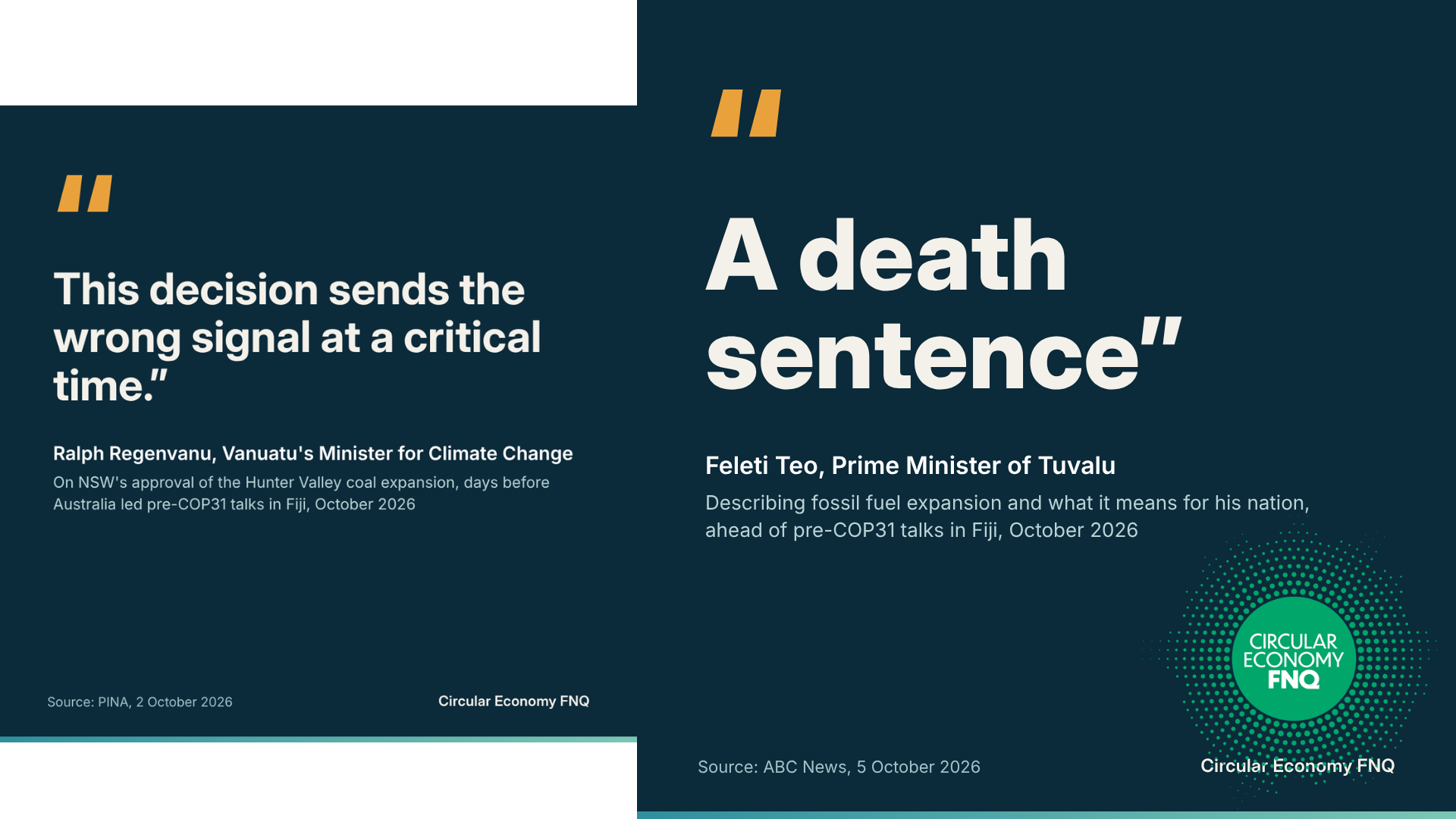
The Hunter Valley approval landed days before Australia led pre-COP31 talks in Fiji, and Pacific leaders said so out loud. Vanuatu's Climate Minister Ralph Regenvanu called it "the wrong signal at a critical time" and asked the Prime Minister to reflect on "the trust we need" heading into COP31. Tuvalu's Prime Minister Feleti Teo described fossil fuel expansion as a "death sentence" for his nation.
Australia wants to be the Pacific's "partner of choice". It funds adaptation and renewables, and it is pushing security deals across the region. But every new coal and gas approval undercuts that pitch. At the 2026 Pacific Islands Forum in Palau, leaders backed a goal of 100% renewables by 2035, while our exports remained a source of "quiet frustration".
That's the opening China is waiting for. To be fair, Pacific nations have so far largely rebuffed Beijing's security and trade proposals. Some leaders also bristle at being told who to criticise: when Palau pushed to condemn China's July missile test near Tuvalu's waters, Kiribati and Nauru blocked the statement. So the Pacific isn't simply choosing China. But trust is the currency of the region, and Australia is spending it on coal & Rugby - $600million a year when the locals don't even want it over hospitals and other services.
Every time we say "we're family" and then approve another mine, we make Beijing's pitch easier.
The Hand That Fuels Us: Japan, The Beetaloo And The Gas Tax
This is where the saying bites. Japan is one of Australia's biggest gas customers and a major investor in our gas fields, and that relationship sets the limits of what our governments will do.
In March 2026, Japan's largest oil and gas company, INPEX, signed a farm-in deal in the Northern Territory's Beetaloo Basin. Its aim is to feed fracked gas into its Ichthys LNG export plant in Darwin. Beetaloo gas began flowing into the NT grid on 1 September 2026.
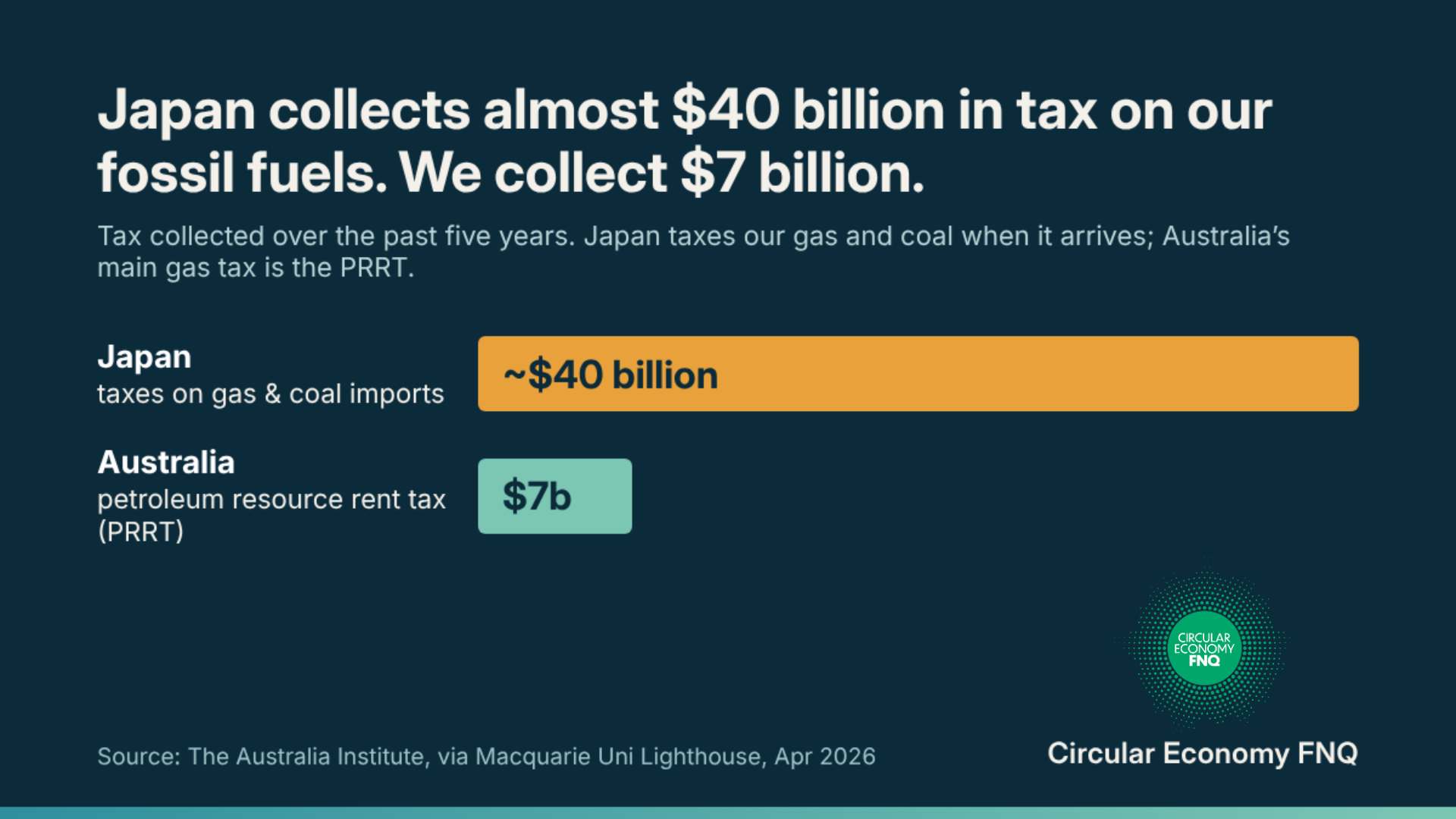
Meanwhile, a proposed 25% tax on LNG exports has been gathering support. The Australia Institute estimates it would raise about $17 billion a year. Over the past five years Japan collected almost $40 billion in taxes on gas and coal imports, while Australia raised $7 billion from its petroleum resource rent tax. And Japan resold more than twice as much gas in 2024 as Australians used at home.
So who argued against the tax?
A June 2026 analysis found most fossil fuel companies opposing it cited Japan's energy security, not Australia's. In the May budget, Treasurer Jim Chalmers declined to go further, saying there were "good reasons to prioritise fuel supply and gas reservation".
No one in Canberra will say "we can't upset Japan." But when the industry's main argument is another country's energy security, and Australia imports most of its own liquid fuel, the message is clear: don't bite the hand that fuels you. Japan is also our biggest Green Hydrogen client and SA has just had an environmental disaster that SA refuses to call around the 4 largest desalination plants in the region.
Saying No, And Building Something Better
A 25% gas export tax would make Australia a less appealing place to explore for new gas. That's exactly why we support it. Our neighbours, our Reef and our kids need us to say no to new fossil fuel exploration.
But saying no is only half the answer.
Regional communities also need a new source of income, one that stays here instead of flowing offshore.
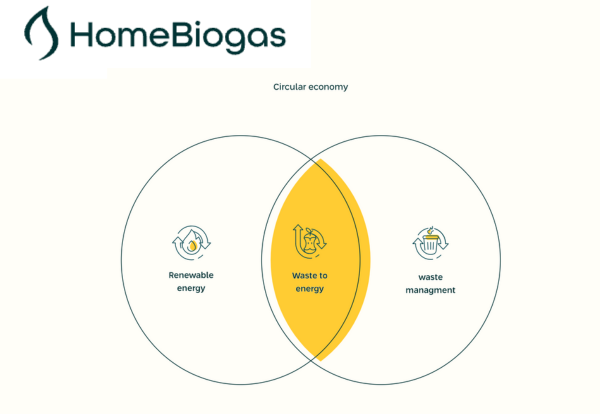
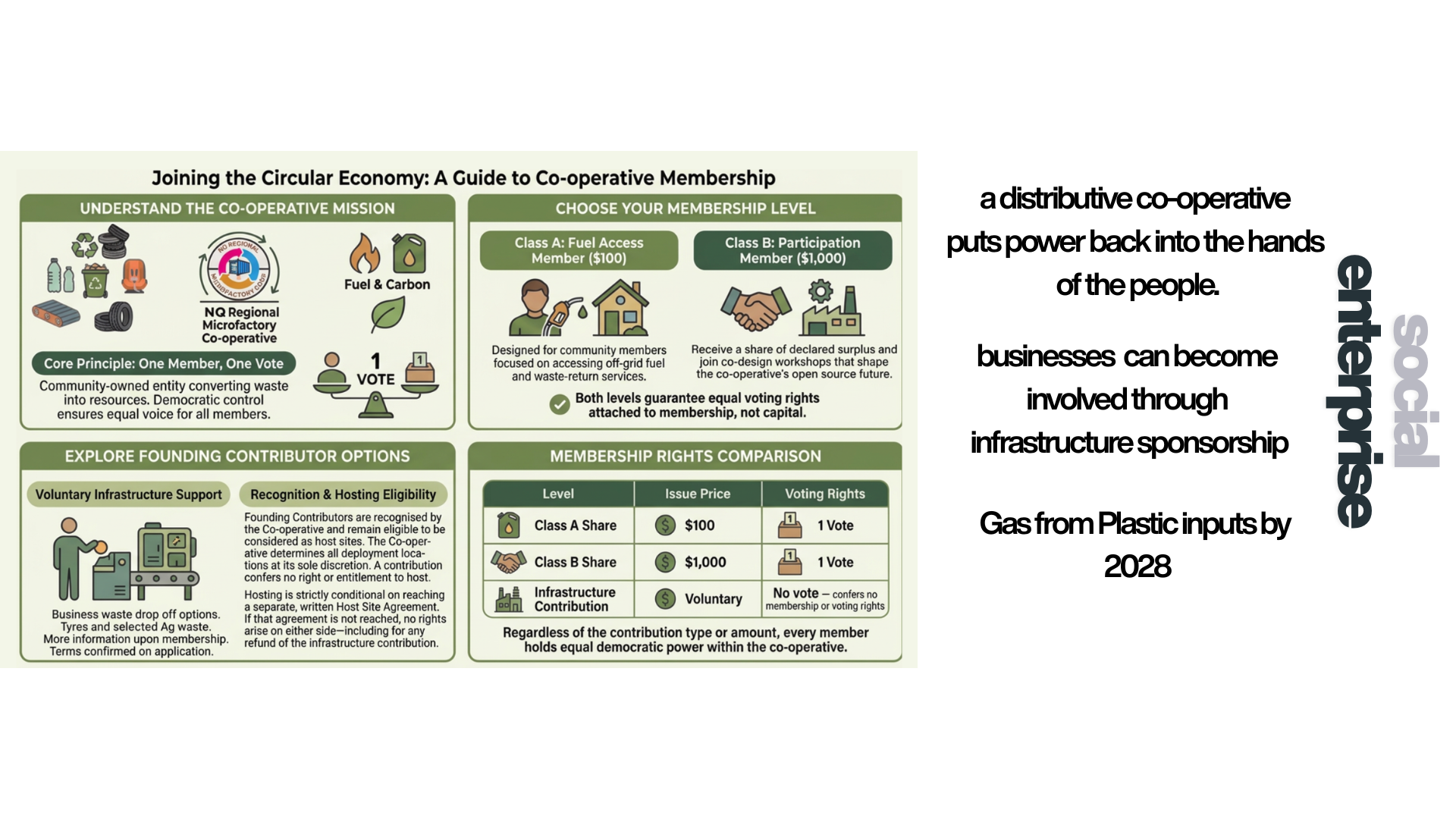
That's why we back the NQ Regional Microfactory Co-operative's waste-to-energy solution. It turns local waste into local energy, keeps overheads to a minimum, and returns 70% of its surplus to co-op members.
The Australians who choose to support it are the ones who benefit.
And it's already starting. Cassowary Coast Regional Council is setting the precedent by partnering with the co-op on a pilot here in our region.
What you can do:
- Tell your federal MP the Hunter Valley project still needs federal approval, and that you want it refused.
- Back a fair 25% tax on gas exports.
- Find out how to become a member of the NQ Regional Microfactory Co-operative.
- Spam Cristafulli
The hand that fuels us today won't feed our kids tomorrow. Let's build the one that will.
Sources
Climate Council: Hunter Valley Operations — what happens now NSW has approved its biggest-ever coal project
InDaily Queensland: Crisafulli govt approves habitat-clearing coal mine expansion (13 March 2026)
The Australia Institute: Fossil fuel subsidies in Australia 2026, 2025, 2024
PINA: Pacific leaders slam NSW government coal mine decision ahead of UN climate summit (2 October 2026)
ABC News: Pacific leaders challenge Australia's fossil fuel expansion ahead of pre-COP31 talks in Fiji (5 October 2026)
ABC News: Security, climate change and drugs on agenda at Pacific Islands Forum leaders meeting (31 August 2026)
Market Forces: Beetaloo — fracking the heart out of Australia
ABC News: Fracked gas from Beetaloo Basin flowing to NT power grid (1 September 2026)
Macquarie University Lighthouse: Push for 25% gas export tax intensifies as inquiry hears billions are being lost (April 2026)
The Point: Japan on-sells almost twice as much gas as Australians consume
Carbon Pulse: Australian gas industry invokes Japan's energy security to fight proposed LNG export tax (21 June 2026, paywalled)
ABC News: Chalmers reveals gas tax revenue is up in federal budget (10 May 2026)
Added for Queensland, AI and the Olympics
- ABC News: Albanese to settle AI data centre energy rules, overriding defiant Queensland (24 August 2026)
- RenewEconomy: Queensland insists it will power data centres with coal and gas (September 2026)
- InDaily Queensland: Green light for billion-watt data centre in SEQ (17 September 2026)
- ABC News: Queensland government unveils long-term tourism strategy Destination 2045 (2 June 2025)
- The Fifth Estate / The Conversation: Brisbane 2032 is no longer legally bound to be 'climate positive'
Launching Your (Citizen) Journalism Career
Everything in this blog came from public records, published research and reporting. You can find it too. We want more citizen researchers in FNQ asking hard questions, checking the answers, and publishing what they find.
The rest of this post is your starter kit: who's pushing for fracking, how government props it up, who's pushing back, and the tools and questions to dig further. #bettertogether
Our feedback loop: The Australia Institute. The Australia Institute is one of the country's most formidable independent research bodies on fossil fuel subsidies and gas tax. Use its reports to check your numbers and sharpen your questions. Then do what good researchers always do: ask the next, harder question.
Our one rule: always ask the hard next-step question. Every section below ends with some to start you off.
Who Is Pushing For Fracking, And Where
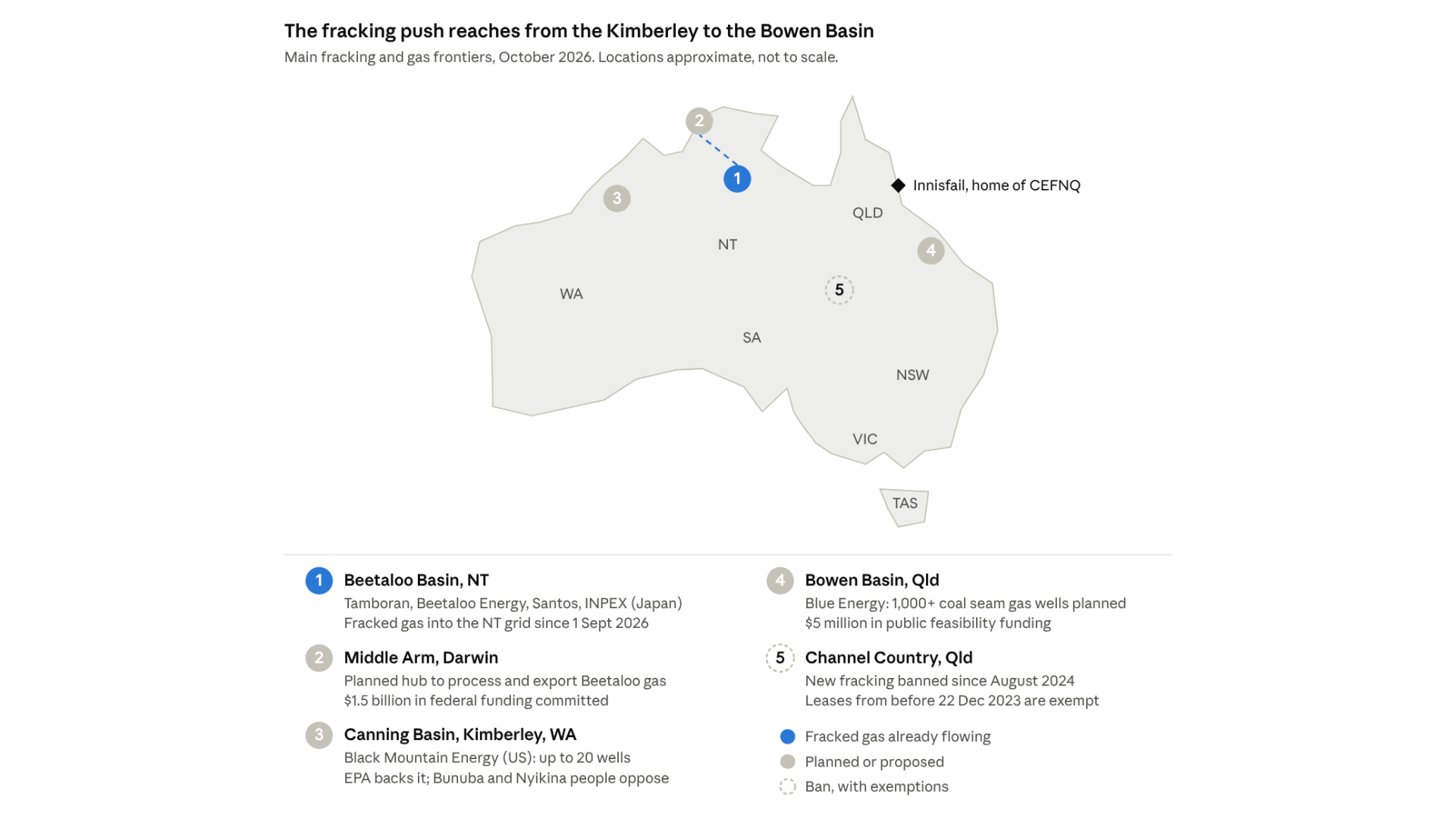
The biggest fracking push is in the Northern Territory's Beetaloo Basin, but it isn't the only one.
| Where | Who Is Pushing This | What's Happening |
|---|---|---|
| Beetaloo Basin, NT | Tamboran Resources, Beetaloo Energy Australia, Santos, INPEX (Japan), APA Group pipelines (Market Forces) | Fracked gas began flowing into the NT grid on 1 September 2026. The NT government's supply contract with Beetaloo Energy is secret under cabinet-in-confidence. |
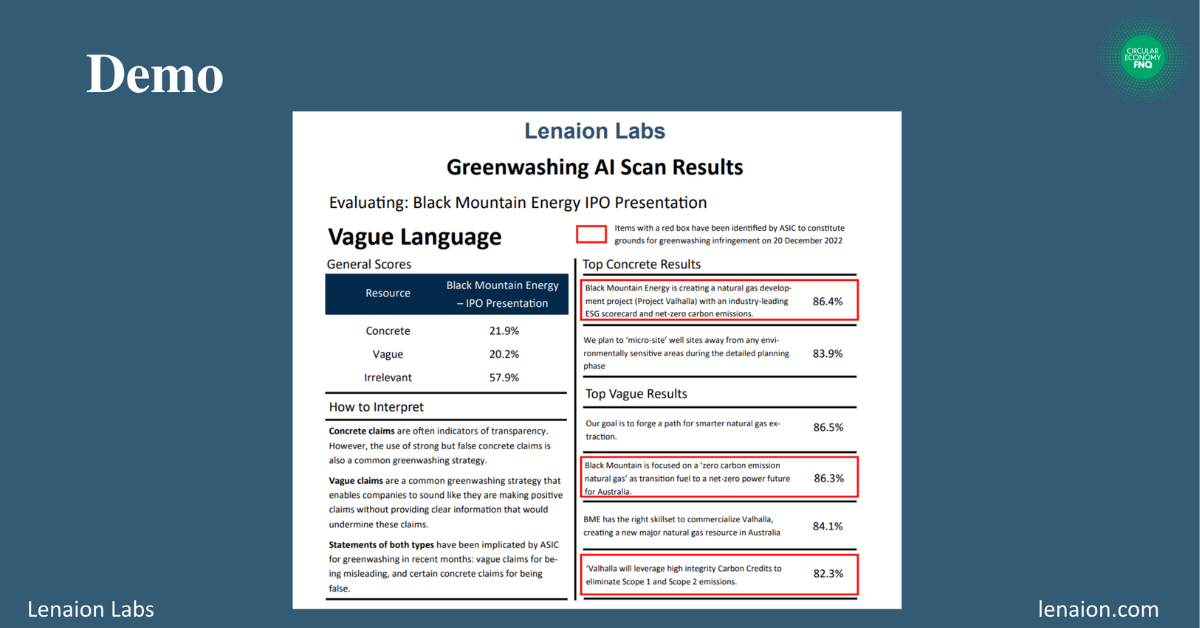
| Canning Basin, Kimberley, WA | Black Mountain Energy (US), through Bennett Resources | WA's EPA recommended approval of up to 20 exploration wells near the Martuwarra Fitzroy River in January 2026. Bunuba and Nyikina Traditional Owners oppose it. The WA environment minister decides. |
| Bowen Basin and Channel Country, Qld | Blue Energy and others | Blue Energy plans more than 1,000 coal seam gas wells. Queensland banned new fracking in the Channel Country from August 2024, but leases from before 22 December 2023 are exempt. |
Hard Next-Step Questions
- What is in the NT's secret Beetaloo gas contract, and what does it cost taxpayers?
- Who holds the pre-2023 Channel Country leases that dodge Queensland's fracking ban?
- Did Traditional Owners give free, prior and informed consent, and who decided what counts as consent?
Support Beyond Policy: How Taxpayers Back Gas
Gas companies wouldn't explore frontier basins without government support. Beyond the $16.3 billion a year in subsidies covered above, that support takes several forms.
- Drilling grants. The Morrison government's $50 million Beetaloo Cooperative Drilling Program paid up to $7.5 million per well. Imperial Oil and Gas alone was offered up to $21 million for three wells.
- Infrastructure. The Albanese government committed $1.5 billion to the Middle Arm precinct in Darwin Harbour, planned to process Beetaloo gas for export. A Senate inquiry couldn't agree on its recommendations.
- Feasibility money. Lock the Gate reports $5 million in public subsidies has already gone to Blue Energy's feasibility study in Queensland.
- Secret contracts. Governments buying gas on terms the public can't see, as with the NT's Beetaloo deal.
- Low tax take. Treasury officials confirmed to Senator David Pocock that offshore gas tax is expected to raise less than the tax on beer.
Hard next-step questions
- Which Beetaloo grant recipients actually drilled, and what did each well cost the public?
- How much of Middle Arm's $1.5 billion has been spent, and on what?
- Check The Australia Institute's subsidy reports: which of these items do they count, and which are missing from the total?
Who Is Bucking The Norm
While both major parties back more gas, a crossbench of independents and Greens is forcing the questions into the open.
- Senator David Pocock (Independent, ACT). He asked Treasury to confirm that offshore gas tax would raise less than beer tax. The 57-second clip on Instagram reached nearly 10 million views, and he argued for a 25% gas export tax. He votes issue by issue, and he isn't afraid to call out the Greens either. That's why we like him.
- Senator Steph Hodgins-May (Greens, Vic). She chairs the Senate Select Committee on the Taxation of Gas Resources, set up by the Greens and independents in March 2026.
- Senator David Shoebridge (Greens, NSW). He became Greens leader on 30 September 2026 after Larissa Waters stepped down, promising "a red-hot fight" for a safe climate.
- Others in the crossbench. Independents opposed the Middle Arm gas hub in the Senate inquiry. Find out who your own MP and senators are, and check how they voted.
Follow The Conversation On TikTok and Instagram
- Search each politician's name on TikTok and Instagram. Only follow accounts linked from their official website or parliamentary profile, to avoid fakes.
- Open the comments and the "stitches" and "duets" on their videos. That's where you'll find other researchers, journalists and industry voices.
- Follow those threads to their sources. Every claim in a video should lead back to a document, report or Hansard record.
- Save links as you go, with the date. Videos get deleted.
Hard Next-Step Questions
- How did each crossbencher vote on gas tax, Middle Arm and new fossil fuel projects? Words are cheap; votes are on the record.
- Who funded the multi-million-dollar gas industry counter-campaign to Pocock's video?
- What would it take for the major parties to support a gas export tax?
Your Investigative Toolkit
These free public tools are where investigative journalists start.
| What you want to know | Where To Look |
|---|---|
| What politicians said, and how they voted | Parliament of Australia: Hansard and divisions |
| What officials told senators under questioning | Senate Estimates and committee hearings on aph.gov.au |
| Who donates to which party | https://transparency.aec.gov.au/ |
| Who lobbies government | https://lobbyists.ag.gov.au/ |
| Which companies got grants | Grant Connect |
| Documents the government hasn't published | Freedom of Information requests, e.g. through Right to Know |
| Which projects need federal environment approval | EPBC Act public portal |
| Fossil fuel subsidies and gas tax research | The Australian Institute |
| Coal and gas projects worldwide | Global Energy Monitor |
Habits Of A Good Investigator
- Follow the money. Grants, donations, contracts and tax. Money leaves a paper trail.
- Go to the primary source. A news story or TikTok is a lead, not evidence. Find the report, Hansard page or contract.
- Confirm with two independent sources before you publish a fact.
- Keep a research log: what you found, where, and the date.
- Separate fact from opinion. Say clearly which is which.
- Give a right of reply. Ask the company or politician for comment before you publish.
- Be careful with claims about people. Stick to what the record shows, to stay fair and avoid defamation.
- Check your feedback loop. Test your findings against The Australia Institute's research, and test theirs too.
The Questions Every Investigator Should Ask
- Who benefits, and who pays?
- Who decided, and when?
- What is being kept secret, and why?
- What did they promise, and what did they do?
- Who hasn't been asked, especially Traditional Owners and affected communities?
- What's the next document I need to see?
Get Published With Us
Circular Economy FNQ wants to publish independent research from citizen researchers. Your work can reach councils, schools, researchers and decision-makers in rooms where it counts. We are having more inperson events where doing a short 10min talk with following community discussion is part of our new How We Do Things with the NQ Regional Co-Operative.
To pitch your research:
- Pick one question from this post, or your own.
- Do the digging with the toolkit above, and keep your research log.
- Send us a short pitch: your question, what you found, and your main sources.
- Work with our editors to check the facts and prepare it for publishing.
Students are especially welcome. Your research career can start here. #bettertogether
Added for the research starter kit
- ABC News: Gas vs beer: how David Pocock's 57-second video caused the government a weeks-long tax headache (2 May 2026)
- ABC News: David Pocock argues for 25% tax on gas exports (21 April 2026)
- ESD News: Greens and independents secure Select Committee on gas tax
- Newsbeep: New Greens leader David Shoebridge (30 September 2026)
- ABC News: Beetaloo Basin gas piped north to 'keep the lights on' in NT (9 December 2025)
- ABC News: WA regulator recommends Valhalla gas project in Kimberley (20 January 2026)
- Lock the Gate: Fracking company's northern scramble
- ABC News: Fracking ban takes effect in Queensland's Channel Country (4 August 2024)
- Minister for Resources (2021): Grants to help speed up Beetaloo drilling program
- The Conversation: Inquiry raises deep concerns over Labor's $1.5 billion cash splash for new NT gas hub