Who Owns Our Rubbish? The Quiet Money in Waste
Your Bin Is A Business
Every time you put out your bin, you're feeding a multi-billion-dollar industry. Much of that industry is owned by large international companies, and the newest technology being sold to our councils is designed and built overseas.
That money could stay in our communities. In Far North Queensland, we're supporting a way to make sure it does.
Follow The Money
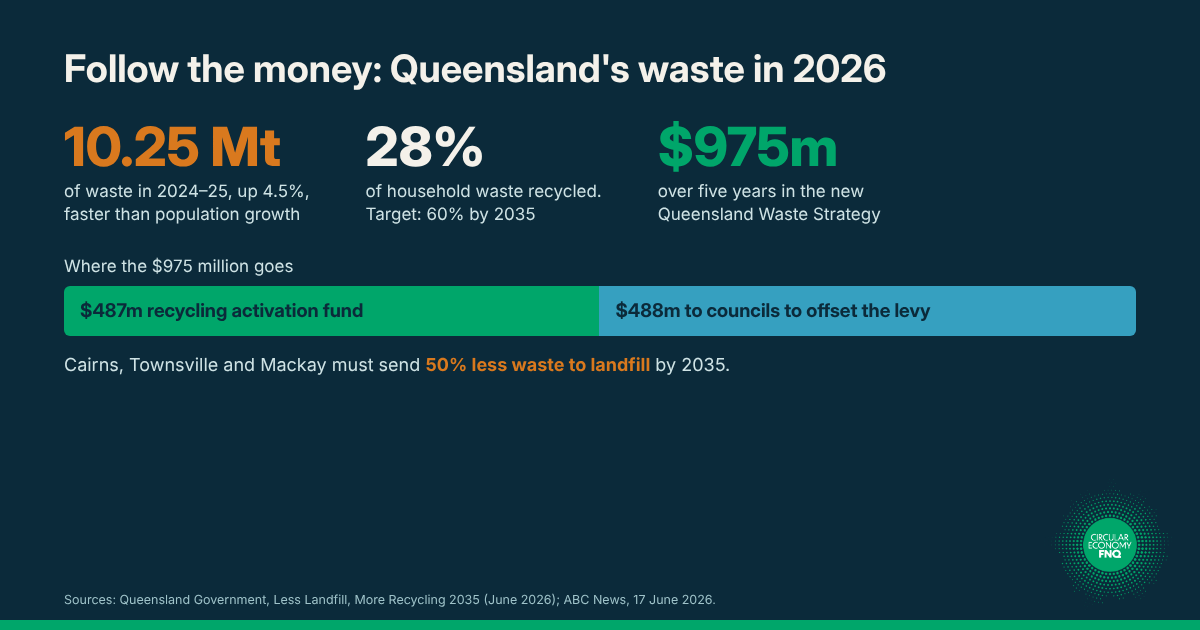
Australians spent about $17 billion on waste collection, treatment and disposal services in 2018–19, according to the Australian Bureau of Statistics. On top of that, state landfill levies raise an estimated $2.7 billion a year, but only about $1.2 billion of it goes back into waste and recycling (Inside Waste).
That's faster than our population grew (ABC News). Only 28% of household waste is recycled, and the state government itself calls Queenslanders the second-worst recyclers in the country.
In June 2026 the government released Less Landfill, More Recycling 2035, its new 10-year Queensland Waste Strategy. It comes with $975 million over five years: $487 million for a Waste Reduction and Recycling Activation Fund, and $488 million in payments to councils to offset the levy on households. The targets that matter for us:
- 65% recycling statewide by 2035
- 50% less landfill in the major regional hubs: Cairns, Townsville and Mackay
- Rural and remote areas: hold landfill at current levels
- An $11 million Regional Recycling Transport Fund to move recyclables from regional areas to processing (Queensland Government)
Levies vs Gate Fees: What You're Actually Paying For
When you or your council take waste to the tip, the bill can include two very different charges.
| Landfill Levy | Gate Fee (tip fee) | |
|---|---|---|
| What Is | A state government tax on every tonne buried in landfill | The price the tip operator charges to accept your waste |
| Who Sets It | The state government | Whoever runs the tip: a council or a private company |
| Where Does The Money Go? | State government. Some funds recycling; much goes elsewhere. | The operator, to run the site, and as profit if it's a private company |
| What's It For? | To make landfill more expensive so recycling looks better | To cover staff, machinery, landfill cells, rehabilitation and profit |
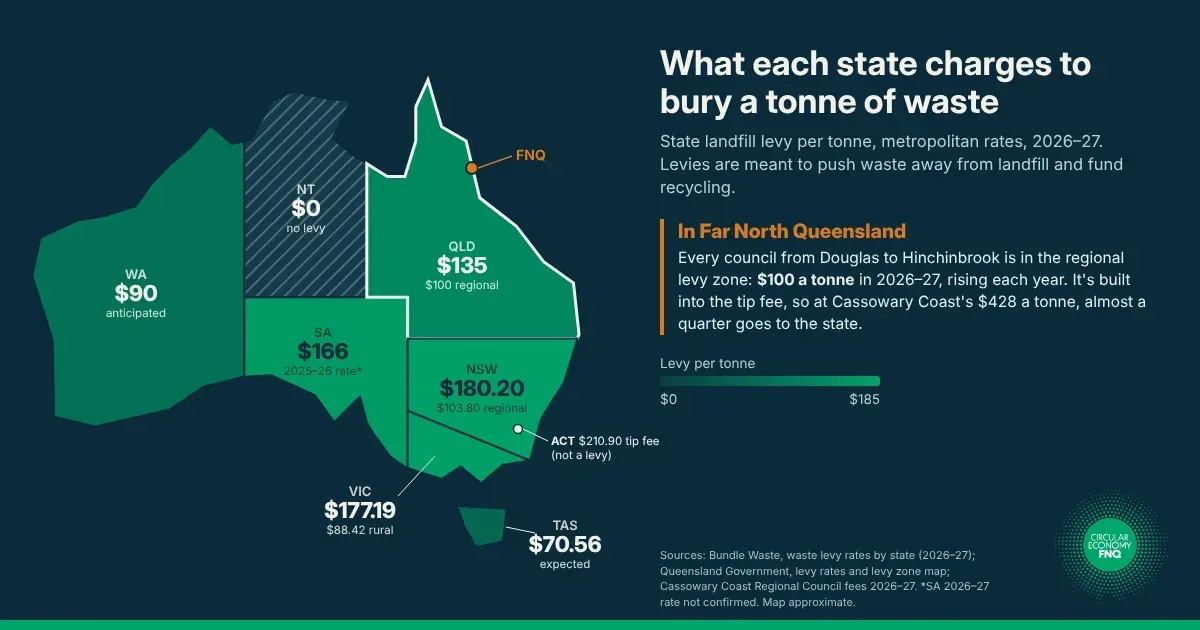
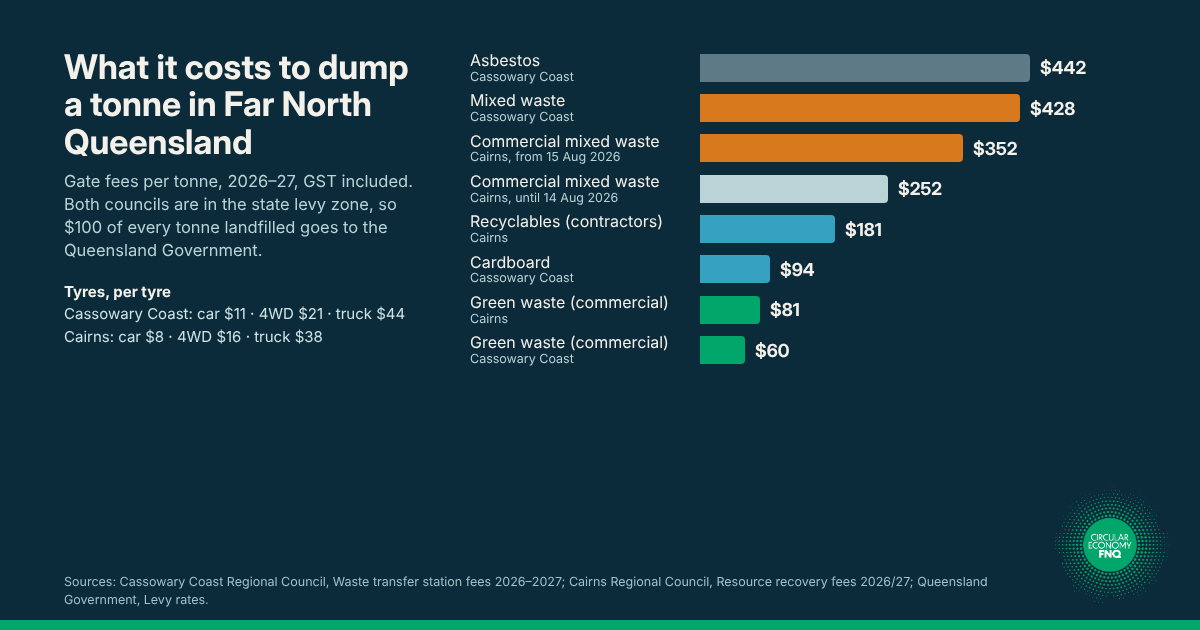
| Example | Queensland regional zone, which includes every FNQ council from Douglas to Hinchinbrook: $100 a tonne (2026–27) | Cassowary Coast transfer stations: $428 a tonne for mixed waste, levy and GST included (2026–27) |
Inside the levy zone, the gate fee includes the levy. Cairns, Cassowary Coast, Douglas, Tablelands, Mareeba, Hinchinbrook and Townsville are all in Queensland's regional zone (levy zone map), so $100 of every tonne buried goes to the state. At Cassowary Coast's $428 a tonne, that's almost a quarter of the bill. In Cairns, commercial mixed waste jumped from $252 to $352 a tonne on 15 August 2026.
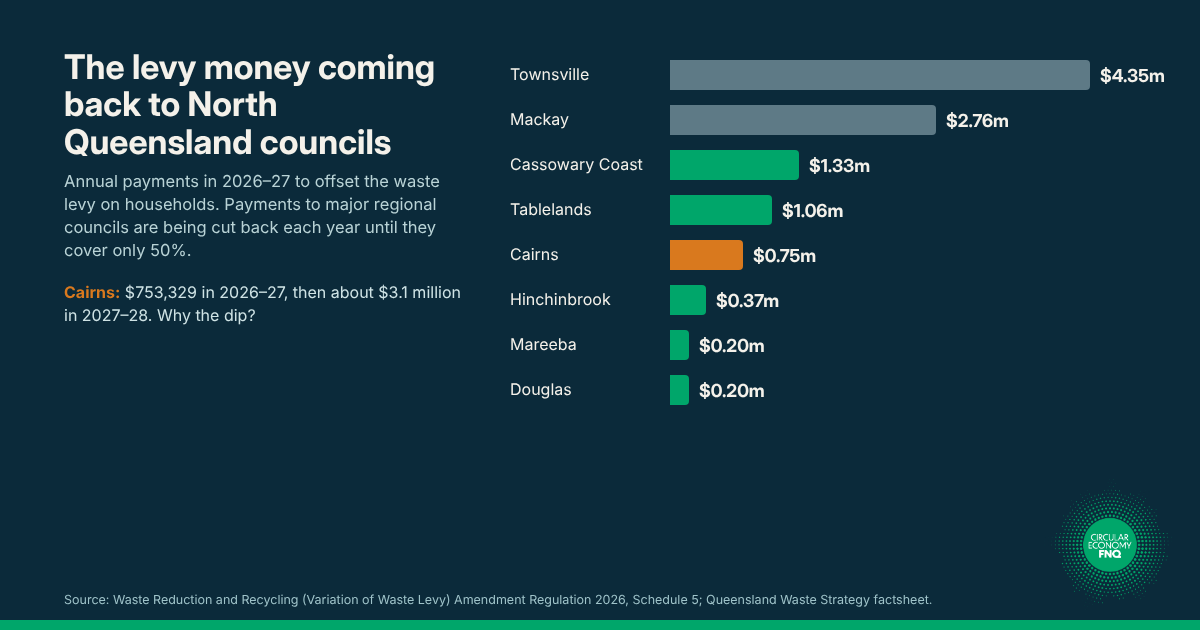
The state hands some of the levy back to councils so households don't feel it. In 2026–27, Cassowary Coast gets about $1.33 million and Cairns $753,329, rising to about $3.1 million the year after (Waste Reduction and Recycling Amendment Regulation 2026). But payments to major regional councils like Cairns are being cut back each year until they cover only 50%, matched to the new landfill target (Queensland Government factsheet). Every tonne Cairns can't divert will cost it more.
Here's the key point. The levy goes to government, but the gate fee is where the business is. Whoever owns the landfills, transfer stations and waste-to-energy plants collects gate fees on every tonne, often under contracts that run for decades.
Who's Cashing In
Some of the biggest names in Australian waste are headquartered overseas. When France's Veolia bought fellow French giant Suez, the competition regulator said the two were "two of the largest vertically integrated waste management companies in Australia".
The deal touched more than 60 local markets. Some assets were sold to Germany's Remondis, and others to Australian-listed Cleanaway.
The same pattern shows up in waste-to-energy, the new frontier of waste money. Australia's first two big plants are in Perth:
| Plant | Investors & Technology | Size |
|---|---|---|
| Kwinana Energy Recovery, WA | Owned by Spain's Acciona, run by France's Veolia. Received $113 million in federal funding through ARENA and the CEFC. | 400,000 tonnes a year, $668 million to build |
| East Rockingham, WA | Investors include the UK's John Laing, the UAE's Masdar, Acciona and Hitachi Zosen Inova, which also supplies the technology. Veolia runs it under a 20-year contract. | 300,000 tonnes a year |
| NQ Regional Microfactory Co-Operative Cassowary Coast Council | Owned by the community with a Pyrolysis Unit - Australian Technology that are decentralised into smaller units to avoid the Red Cycle issue of one solution and going down if there is a critical error or fire. | 5k tonnes per transfer station |
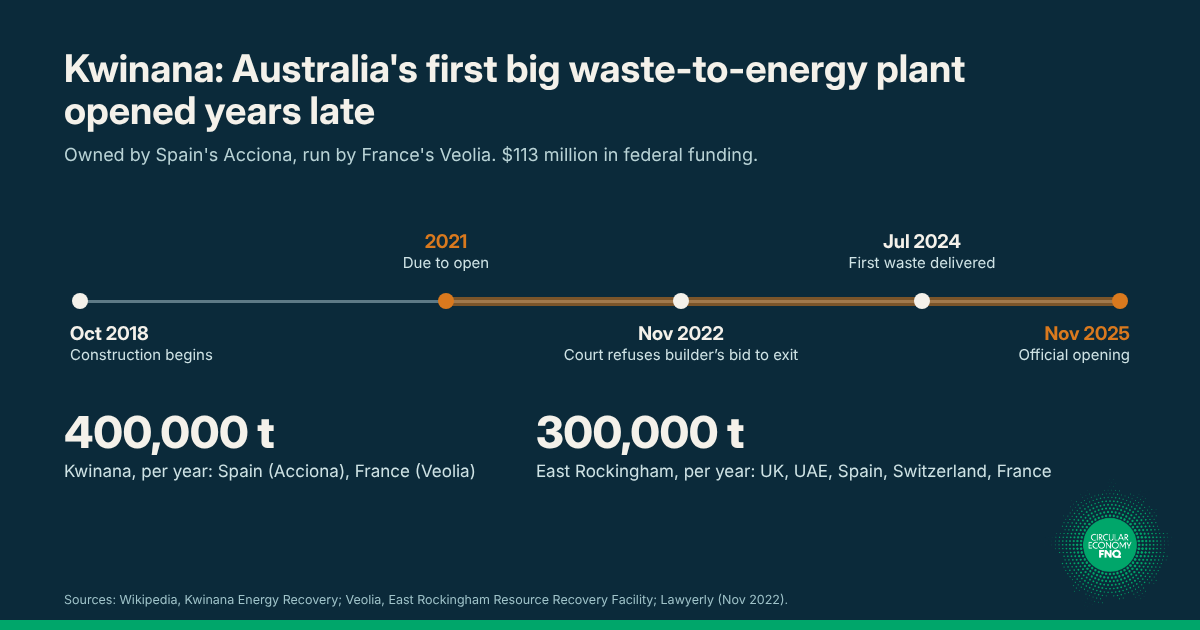
Kwinana shows the risk. It was due to open in 2021. Construction was hit by COVID-19 and the building boom that followed, with labour and materials hard to get. The builder, Acciona, tried to walk away from the contract, but in November 2022 the WA Supreme Court refused to treat COVID-19 as a force majeure event. First waste wasn't delivered until July 2024. Meanwhile, the eight local councils it serves were waiting on a plant meant to handle about a quarter of Perth's leftover waste.
Now it's running, the claims have started. Premier Roger Cook said the plant will divert about 460,000 tonnes of waste a year, "cutting emissions equivalent to removing 85,000 cars from our roads".
But burning waste releases CO2 from the chimney. The "cars" figure rests on assumptions: that the waste would otherwise rot in landfill and release methane, and that the plant's electricity replaces coal power.
An independent analysis for a landfill-gas company found Kwinana's real savings were likely about 80% lower than claimed, and could disappear within a decade as the grid gets cleaner and more plastic ends up in the furnace. The plant's own commissioning report also admits "temporary exceedances" of emission limits while equipment was being tested.
None of this is illegal or secret. But it is quiet. Long contracts, overseas technology and offshore profits mean that when our communities pay to get rid of waste, much of the value leaves the region.
The Granny Flat In A Day Lesson
We've seen this story before with housing. Granny flats "in a day", prefabricated overseas and shipped in, promise a fast, cheap answer. But many arrive built to someone else's rules.
Engineers say imported modular buildings often fail Australian compliance. Some are designed for wind speeds of around 100 km/h, when parts of Australia need 120–150 km/h or more. Steel grades, footings and seismic design often don't meet Australian Standards. In Queensland, owners also need cyclone ratings, termite barriers, Australian electrical work and an engineer's certificate, and many engineers won't certify these products without upgrades. The "cheap" option ends up costly.
As one engineering firm put it: "Engineered overseas does not mean compliant in Australia."
Waste technology is no different. A system designed for Europe's cold, dense cities isn't automatically right for a cyclone-prone, tropical region with small towns spread far apart. It has to meet our environmental licensing, our standards and our conditions.
In a meeting with a Circular Economy representative of a council we heard the Prime Minister is keen to support Australian tech over imported.
Closer To Home: The Cairns Problem
Far North Queensland has its own version of this story. Five councils pay to send their waste to Cairns. For 20 years, much of it went through the Bedminster plant at Portsmith, which pulled compostable material out of general waste. In January 2025, a fire destroyed the plant. Investigators' first suspicion was a lithium battery.
Since then, about 125 tonnes of waste a day that used to be diverted now goes to landfill instead. And Cairns' general waste is trucked 70 kilometres up the Kuranda Range, through the World Heritage-listed Wet Tropics, to Mareeba's Springmount landfill.
Rather than for example Veola, the smaller of the waste management businesses in FNQ, having 6 trucks doing 3 trips a day, 6 days a week, if we processed that waste in each councils footprint, we won't have to drill through a mountain to put in a tunnel, we reduce the amount of trucks using the Kuranda range. REduce not REdesign.
Cairns' contract for its main waste facility was due to expire in 2026, and the council is planning what comes next through its Resource Recovery 2040 roadmap. But the answer doesn't have to come from Cairns.
Every tonne a smaller council processes locally is a tonne it no longer pays to truck to Cairns. If the surrounding councils run their own microfactories, less waste goes to Cairns, the gate fees stay home, and the trucks stay off the range.
The state has paid to move our waste before.
Its earlier Regional Recycling Transport Assistance Package gave $6 million in grants of up to $250,000 to truck recyclables out of regional Queensland to be processed elsewhere.
It moved more than 80,000 tonnes. Far North councils shared in it: Cairns ($250,000), Northern Peninsula Area ($221,000), Douglas ($187,500), Cook ($105,677), Mareeba ($51,548) and Tablelands ($46,000). Tyres got money too: Mackay-based JMJ Tyre Recycling received $187,500 to move tyres to be recycled.
The new strategy brings it back as an $11 million Regional Recycling Transport Fund, part of the $487 million activation fund. It isn't open yet, and the rules haven't been released.
That leaves a big question: will it only pay to truck our recyclables hundreds of kilometres away, or will it also pay for the short trip to a microfactory down the road?
Our Answer: Keep The Value Local
This is paragraph text. Click it or hit the Manage Text button to change the font, color, size, format, and more. To set up site-wide paragraph and title styles, go to Site Theme.
| Who | Role |
|---|---|
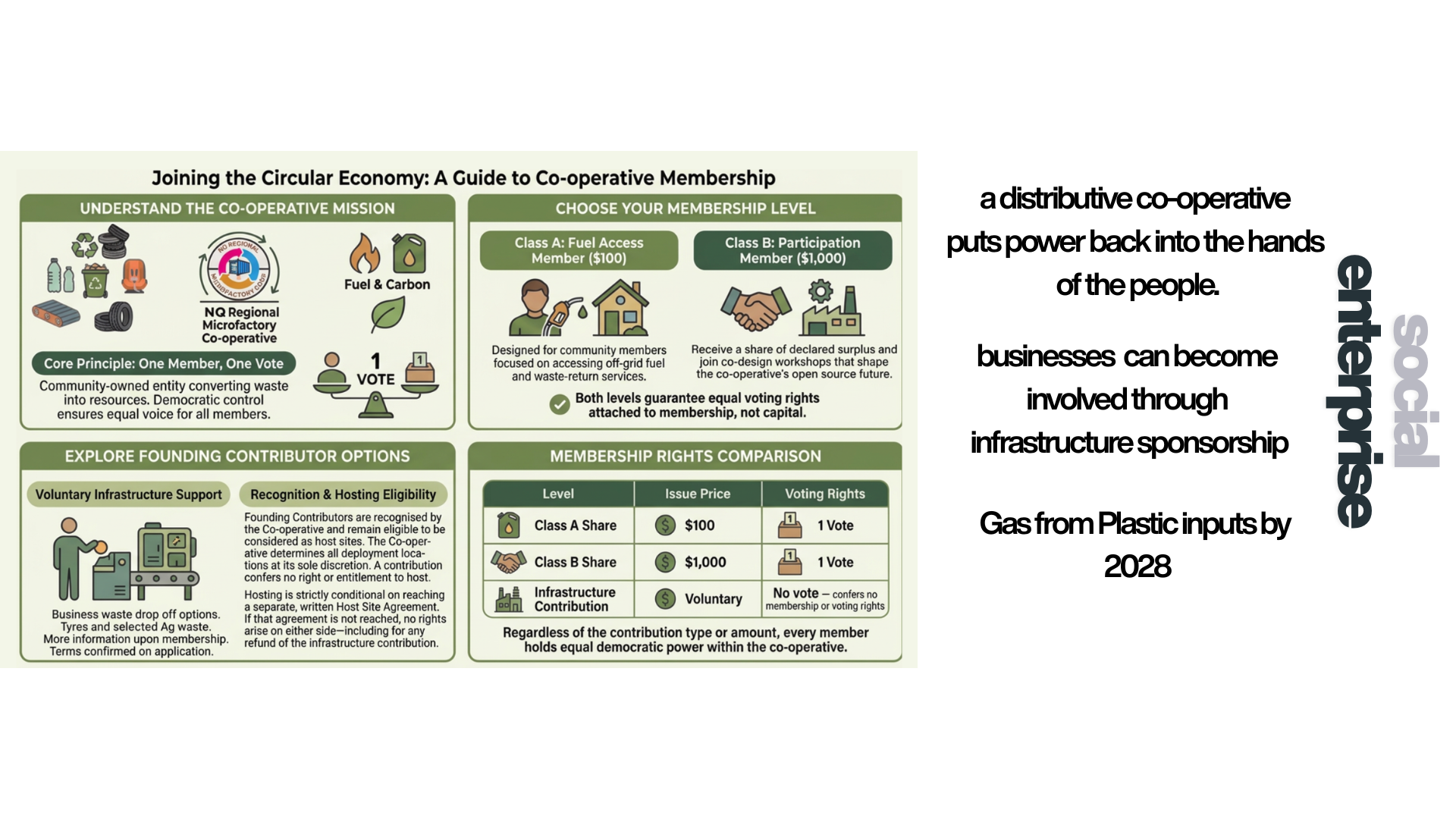
| WeMadeIt. (WMI) | A certified social enterprise that developed and launched the distributive model and the Aquarius Microfactory. |
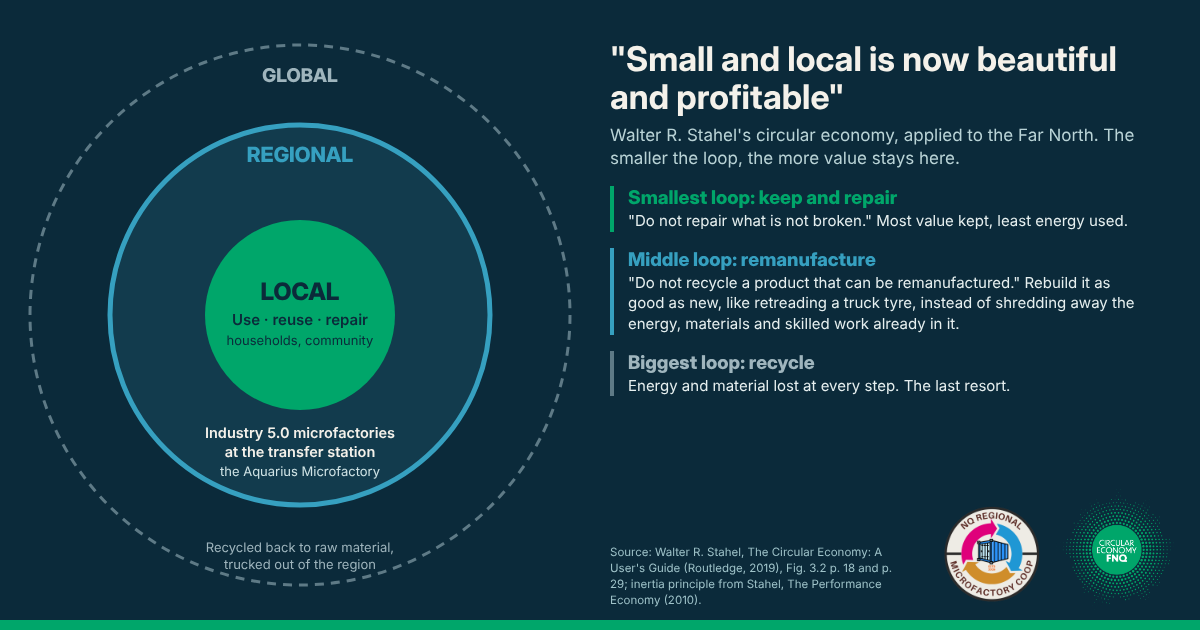
| NQ Regional Microfactory Cooperative | Community-owned. It delivers the model on the ground, turning local waste such as tyres into energy and useful products at microfactories close to home. |
| Circular Economy FNQ | The education arm. It supports the co-op by teaching the community, from kids in libraries to members learning to run their co-op. |
What makes it different:
- Owned by the community. Members join the co-op, and it's one member, one vote.
- The surplus stays here. 70% of the surplus stays with the co-op, shared among Participation (Class B) members and the community projects members vote for, such as affordable housing.
- Built for our conditions. Every site works towards Queensland environmental licensing, and the technology is developed for regional, tropical North Queensland.
- Small and spread out. Microfactories sit near existing transfer stations, so waste doesn't have to travel to a mega-plant hundreds of kilometres away. Decentralised solutions are a key strategy in the Circular Industrial Economy.
- Councils as partners. Cassowary Coast Regional Council is partnering with the co-op on a pilot, setting a precedent for councils across the region.
The Hidden Value: Data
Waste isn't only worth money by the tonne. Knowing exactly what's in it, where it came from and where it went is worth money too, and right now that knowledge mostly sits with whoever runs the tip.
- Climate and ESG reporting. Australia's largest companies now have to report their climate impact, and waste is part of it. Verified waste data helps them do it.
- Product stewardship. Schemes like tyre stewardship rely on proof of what was collected and what it became.
- Carbon credits. Credits are only as good as the measurements behind them.
- Better planning. Councils that know their waste can plan collections and size facilities properly, instead of signing up for a plant that's too big.
- Safety. Knowing how many lithium batteries end up in general waste matters. One is the suspected cause of the fire that destroyed Cairns' Bedminster plant.
In the co-op model, that data belongs to the community. Members and councils can see it, use it and benefit from it, measured against international circularity standards like ISO 59020.
The waste is ours. The value should be too.
Next-step Questions
- Who owns the landfills and transfer stations in your council area, and how long are their contracts?
- How much does your council pay in gate fees each year, and to whom?
- How much of Queensland's levy actually comes back to recycling in the Far North, and why is Cairns' levy payment only $753,329 in 2026–27 when it's about $3.1 million the year after?
- When the $11 million Regional Recycling Transport Fund opens, will it fund local processing in the Far North, or only freight to processors outside the region?
- Cairns has to cut landfill by 50% by 2035, and Bedminster is gone. Where will those tonnes go, and who will be paid to take them?
- When a council signs a 20-year waste deal, who carries the risk if the technology fails or is delayed?
- Who checks that imported waste technology meets Australian standards for our climate before councils commit?
- And for us: how will the co-op prove, in public reports, that the value really does stay local?
What You Can Do?
- Learn about the technology we are supporting by attending an inperson night we also have some other people doing 15min knowledge bites around Financial Literacy as well as circular economy principles.
- Join the NQ Regional Microfactory Co-operative as a founding member. Free Tyre Drop off (Class A) members get a vote now and access to the co-op's fuel from 2028, when fuel supply begins. Participation (Class B) members also share in the surplus, and Class B can be paid through PayPal in four instalments.
- Back community-owned infrastructure if you're a business with a waste stream. Talk to us about how your waste can stay local.
Sources;
- Queensland Government: Less Landfill, More Recycling 2035: Queensland Waste Strategy (June 2026) and strategy factsheet
- Queensland Government: New fund to supercharge Less Landfill, More Recycling 2035 (27 July 2026)
- ABC News: Queensland sets 65 per cent recycling target as waste outpaces population growth (17 June 2026)
- Queensland Government: Levy rates and levy zone map
- Waste Reduction and Recycling (Variation of Waste Levy) Amendment Regulation 2026, Schedule 5 annual payments
- Cassowary Coast Regional Council: Waste transfer station fees 2026–2027
- Cairns Regional Council: Resource recovery fees and charges 2026/27
- ACCC: Veolia's proposed acquisition of Suez not opposed, subject to divestitures (21 December 2021)
- Wikipedia: Kwinana Energy Recovery
- Veolia: East Rockingham Resource Recovery Facility
- Archieng: Why imported modular and prefab buildings fail Australian compliance
- Approvable: Imported a container home or granny flat from overseas? Don't install it in Queensland before reading this
- Queensland Government: Regional Recycling Transport Assistance Package and Funding and grants