Co-Ops 101: 180 Years Of People Owning What They Need
Co-ops 101: 180 Years of People Owning What They Need
Most of the things that keep a town running, like the power lines, the tip, the water treatment plant and the fuel depot, are owned by someone a long way away. When they work, nobody notices. When a cyclone hits, or the contract changes, or the price goes up, the town finds out how little say it has.
There's another way to own things. It's been around for 180 years.
What is a co-operative?
A co-operative is a business owned by the people who use it. Co-ops around the world share seven principles, set by the International Cooperative Alliance:
- Voluntary and open membership
- Democratic member control
- Members' economic participation
- Autonomy and independence
- Education, training and information
- Co-operation among co-operatives
- Concern for community
Two kinds of co-op in Queensland
| Non-distributing co-op | Distributing co-op | |
|---|---|---|
| What it is | A not-for-profit co-op | A co-op that can share its surplus with members |
| Surplus | Can't be shared with members | Can be shared with members under its Rules |
| Disclosure Statement | Usually not needed | Required, so new members understand what they're joining |
Co-ops that worked
- Rochdale, England, 1844. A group of weavers opened a shop they owned together. Their rules became the basis of the co-op principles used worldwide today.
- Germany, 1860s. During an agricultural depression, farmers set up their own credit co-ops so they could borrow when banks wouldn't lend to them.
- Rural America, 1930s. Private power companies wouldn't wire up the farms, so farmers built their own electricity co-ops. By 1956 there were 927 of them, and around 900 still run today.
- CBH Group, Western Australia, 1933. Wheat growers built their own grain elevators to cut handling costs in the Great Depression. Today CBH is Australia's largest co-op, owned by around 3,500 grain-growing businesses, with a turnover of $5.8 billion in 2024/25.
- Capricorn Society, Western Australia. A co-op of independent mechanics and auto repairers who buy together, now one of Australia's top three co-ops and mutuals by turnover.
- Norco, New South Wales. A farmer-owned dairy co-op, owned by the farmers who supply its milk.
- Resource Work Cooperative, Hobart, 1993. A worker-owned co-op running the South Hobart tip shop and turning waste into local jobs.
Co-ops hold up in a crisis
When the 2008 global financial crisis hit, the International Labour Organization looked at how co-ops fared. Its finding: co-ops around the world proved unusually resilient.
Why? They're owned by the people who use them, so they're built to last, not to flip.
Owning it takes learning
A co-op is only as strong as its members' understanding of it. Reading, numbers, digital skills and financial literacy are what let a community own its infrastructure rather than just host someone else's. That's what Circular Economy FNQ is here for: STEEM learning, library programs and free Nibbles of Knowledge nights, open to anyone.
Want to see one up close?
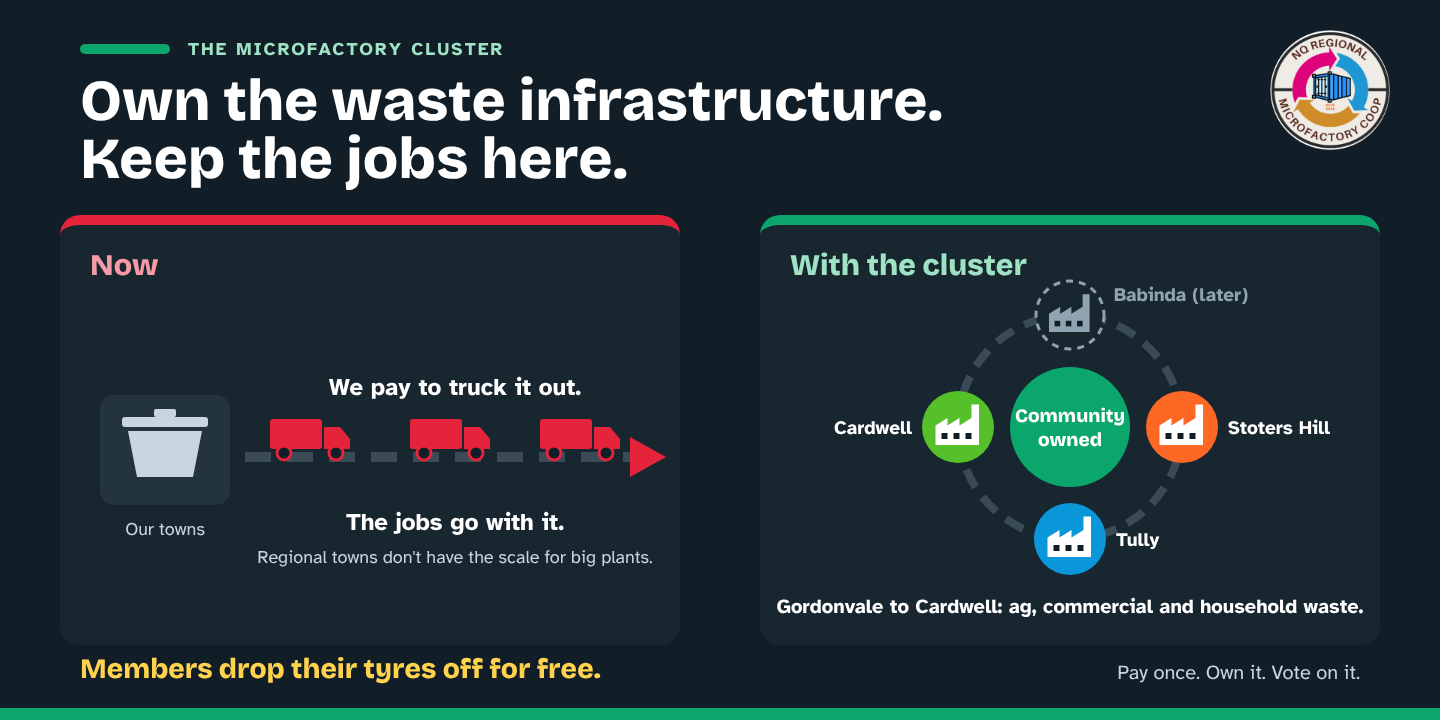
The NQ Regional Microfactory Co-operative is a new distributing co-op in Far North Queensland, building community-owned waste infrastructure. Read how it works, or come to a free Nibbles of Knowledge night and ask your questions in person.
#bettertogether
Sources
- Birchall and Hammond Ketilson, Resilience of the Cooperative Business Model in Times of Crisis, ILO (2009)
- Queensland Government, What is a co-operative
- LPE Project, The legacy of the Rural Electrification Act
- BCCM, CBH Group: a co-operative giant
- Co-op News, Revenues rise 8.4% for Australia's co-op and mutual sector
- BCCM, Resource Work Cooperative
A Distributive Cooperative In A Few Slides